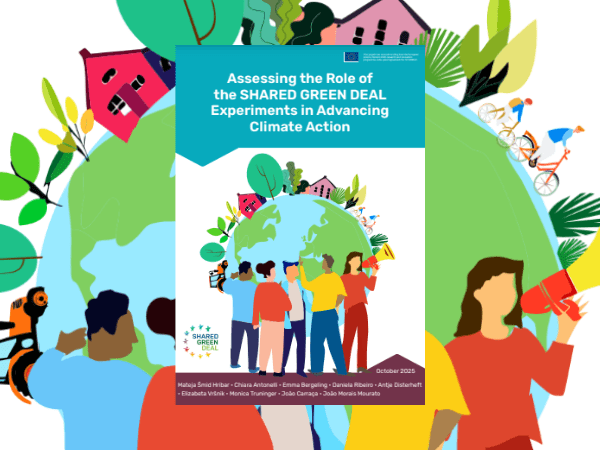
AUTHORS: Mateja Šmid Hribar, Daniela Ribeiro and Elizabeta Vršnik (Research Centre of the Slovenian Academy of Sciences and Arts); Antje Disterheft, Monica Truninger, João Morais Mourato and João Carraça (Instituto de Ciências Sociais, Universidade de Lisboa); Emma Bergeling and Chiara Antonelli (IEEP)
This report summarises key findings from a secondary analysis of the Horizon 2020 SHARED GREEN DEAL project, examining how the project’s six social experiment streams contribute to the European Green Deal’s priority on climate action.
Conducted between 2023 and 2024 in 24 locations across Europe, the social experiments addressed key themes of the Green Deal: Clean Energy, Circular Economy, Efficient Renovations, Sustainable Mobility, Sustainable Food, and Biodiversity Preservation.
The findings show that local participation is crucial to advancing climate action. Each experiment used inclusive, community-based approaches, such as visioning exercises, knowledge networks, and study circles, which successfully fostered behavioural change, strengthened social trust, and enabled practical contributions to both climate mitigation and adaptation goals.
The community-based approach highlights the unique value of participatory methods in building locally embedded responses to global challenges, such as climate change. However, many of the initiatives encountered barriers related to:
- policy misalignment
- bureaucracy
- lack of institutional support
- limited scalability and systemic impact.
Climate benefits often emerged not from direct environmental goals, but as co-benefits of socially or economically motivated activities, such as energy renovations driven by comfort, or food projects motivated by health and affordability. This illustrates the importance of framing climate action in ways that resonate with local needs and values. The report also emphasises ongoing challenges around justice and inclusion. Vulnerable groups, such as rural households, low-income families, and women, often lack access to funding mechanisms or decision-making processes. This reinforces the need for tailored support systems to ensure that climate action is not only effective but equitable. More broadly, the findings underscore the importance of integrated approaches. Across all streams, the fragmentation of policy frameworks among biodiversity, mobility, energy, and food systems hampers the potential for coherent and systemic change. Participatory initiatives such as social experiments can act as important bridges across these domains, but only if they are recognised and supported as such. Considering these findings, the report puts forward several recommendations.
- At the local level, communities should be empowered through participatory methods and supported by context-specific resources, such as funding for local food initiatives, youth-led mobility planning, and small-scale circular economy hubs.
- At the regional and national levels, there is a need to harmonise relevant policies, reduce administrative burdens, and offer long-term funding for initiatives driven by communities and small enterprises. Data systems must also be improved to measure local climate contributions and guide inclusive policy design.
- At European and international levels, efforts should be made to align climate, energy, food, and biodiversity strategies, and to fund transdisciplinary models that combine technological innovation with community empowerment. Platforms for transnational learning and knowledge exchange are key to scaling up what works.
In conclusion, the social experiments analysed in this report demonstrate the potential of community-driven approaches to support climate action. Yet to fully realise this potential, systemic barriers must be addressed, and the social dimensions of environmental change must be better integrated into climate governance. Bridging the gap between grassroots innovation and formal policy is essential for achieving a just and inclusive climate transition in Europe. This is more urgent than ever as the EU is pressing politically for a 90% reduction in greenhouse gas emissions GHG by 2040 in order to better to secure the European Climate Act 2050 climate neutrality targets and comply with UN goals. To this effect, community-driven climate action initiatives are critical both as a territorialised climate policy incubator and accelerator, and as a policy-monitoring platform to ensure a just transition is achieved.
IEEP is a consortium partner within the SHARED GREEN DEAL project, leading the policy and governance work. IEEP coordinates and delivers analysis of EU policy priorities across governance levels, guidance for improved engagement in the next EU budget period, an online Green Deal policy tracker, and stakeholder-specific briefs to inform in-depth roundtable discussions.