AUTHORS: Axel Godfroy, Melanie Muro, Elisabet Nadeu, Isabella Wedl, Julia Jadinzka
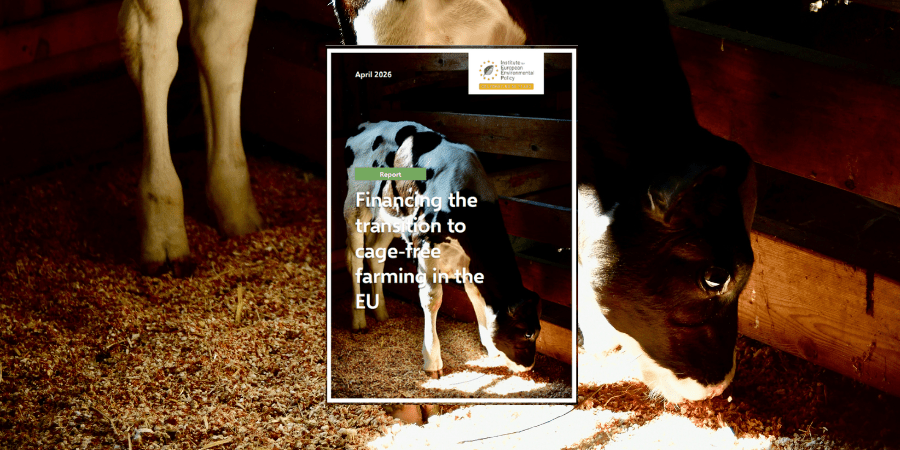
This report provides a comprehensive and up-to-date assessment of how to finance the EU-wide transition to cage-free systems, drawing on scientific evidence, EU policy analysis, national case studies, and interviews with sector experts.
Across the EU, the shift towards cage‑free livestock systems is gaining momentum, driven by changing societal expectations, evolving market commitments, and the forthcoming revision of the EU’s animal welfare legislation. This new IEEP report examines what it will take to phase out cage‑based farming across key livestock sectors, focusing on the economic, regulatory and financing conditions that shape farmers’ ability to invest in higher‑welfare systems.
Momentum to phase out cages in European farming has accelerated in recent years. More than 1.4 million citizens backed the End the Cage Age Initiative, and the European Commission has committed to revising EU animal welfare legislation with species-specific transition periods expected in late 2026. Yet across the EU, over half of laying hens, nearly all rabbits, the vast majority of sows, and a large share of calves are still kept in systems that restrict natural behaviour and rely on confinement.
At the same time, farmers face high upfront investment costs, uncertainty about future EU rules, and limited access to targeted finance. Ensuring a fair, well financed transition is essential for protecting animal welfare while supporting the resilience of Europe’s farming sector.
This report provides a comprehensive and up-to-date assessment of how to finance the EU-wide transition to cage free systems, drawing on scientific evidence, EU policy analysis, national case studies (France, Germany, Poland and Spain), and interviews with sector experts.
Key learnings
1. Legislative certainty unlocks investment
Uncertainty about EU legislation is the single biggest barrier to farmer investment. Countries with clear legal timelines (e.g., Germany on hens and sows) show faster and more confident transitions.
2. Upfront investment is the binding constraint
Structural housing changes, e.g. for retrofits, new barns, land reconfiguration, represent the largest financial hurdle across all species. Access to capital remains limited.
3. Transitions differ substantially between species
- Laying hens: mature alternatives but higher running costs (+22% barn/aviary; +34% free range).
- Pigs: well-designed free farrowing can match performance but requires significant investment.
- Rabbits: need further technical optimisation for breeding does.
- Calves: collective housing feasible with minimal long-term cost impact.
4. CAP funding currently rewards maintenance over transformation
Only a handful of schemes directly support phasing out cages; most payments go to farms already compliant.
5. Demand side measures are powerful but underused
Retailer commitments have driven major progress in Germany and Poland, but mandatory labelling for processed products is still absent, limiting consumer impact.
Key recommendations
For the EU
- Adopt the revised animal‑welfare legislation swiftly, with species‑specific transition periods and accompanying technical guidance.
- Clarify rules for transitional State Aid so Member States can support structural investments linked to future legal requirements.
- Strengthen demand‑side tools, especially harmonised EU animal‑welfare labelling (including processed products).
- Ensure trade policy prevents unfair competition from low‑welfare imports.
For Member States
- Develop species‑specific transition plans that include financing packages, advisory services, and training.
- Prioritise animal‑welfare investments within CAP Strategic Plans and National/Regional Partnership Plans under the future CAP.
- Use the EIB agriculture and bioeconomy facility more strategically, ensuring intermediaries offer products that explicitly support better housing.
This report was commissioned by Compassion in World Farming and Eurogroup for Animals.
Report cover photo by Holly Landkammer on Unsplash