AUTHORS: Carla de Cristofaro and Adrien Partier
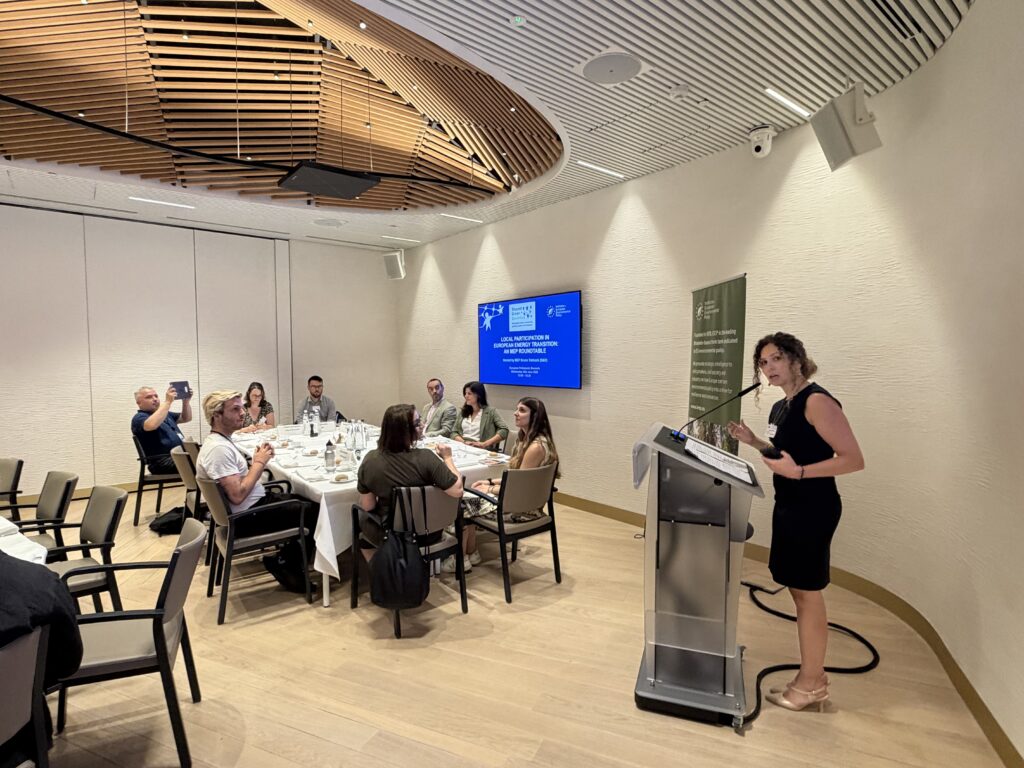
This briefing summarises discussions held during the Science4Policy briefing event organised by IEEP at the European Parliament on 24 June. The roundtable brought together MEPs, policy researchers, civil society and local government representatives to reflect on how to strengthen citizen and community participation in the EU’s clean energy transition.
The roundtable was hosted by MEP Bruno Tobback (S&D) with the participation and contribution of MEP Brigitte Van den Berg (Renew Europe) and MEP Benedetta Scuderi (Greens/EFA) and moderated by Chris Foulds (Professor of Sustainability & Society, Anglia Ruskin University). Speakers included Chiara Antonelli and Irene Chiocchetti (IEEP), Monika Helak (Reform Institute / Think Sustainable Europe), Chris Vrettos (REScoop) and Claire Simpson (Brussels City).
This briefing targeted EU and national institutions engaged in supporting local participation in the energy transition. It draws on a series of social experiments conducted with local stakeholders across Europe under the auspices of the Shared Green Deal project. Research findings will be presented in more detail in a forthcoming policy brief, to be published later this year.
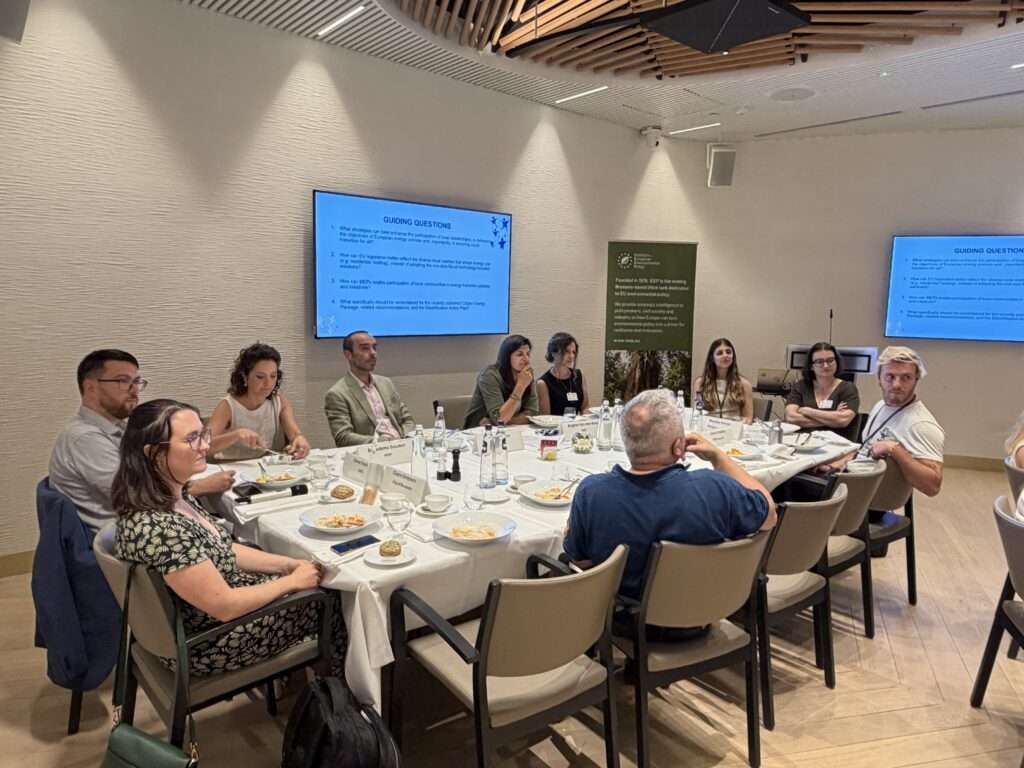
During the discussion, the ambition of the EU’s climate targets and energy transition plans was generally recognised. But implementation at the local level is seen as uneven, and the challenges for local participation in the energy transition were highlighted. One-size-fits-all policy design is poorly suited to local realities, and institutional and financial support for energy communities is often lacking. Furthermore, participation suffers from low levels of trust due to perceived unfairness and opaque consultation processes, and local initiatives are hampered by a heavy administrative burden. Speakers also emphasised power imbalances, calling for EU-level safeguards (minimum benefit-sharing standards, public registries of grid-connection contracts) in the face of active lobbying from established energy interests.
Consensus was reached around key recommendations. Sustained funding and other forms of structural support to energy communities must be forthcoming and scaled up. Participation must be continuous and inclusive throughout the policymaking process, as late-stage information-sharing and top-down governance fail to build trust. Two-way dialogue must be fostered, efforts must be made to reach excluded groups, and the facilitating role of intermediaries in connecting EU-level programmes with local actors must be acknowledged.
Three ongoing legislative files offer near-term opportunities: the Grids Package, the next Multiannual Financial Framework (2028-2034), and the Citizens Energy Package, alongside the Governance Regulation’s forthcoming post-2030 KPI framework. However, a risk was flagged for the next Horizon Europe framework: if competitiveness criteria dominate, the procedural and societal-readiness focus discussed at the roundtable could be lost.
See the event agenda and presentation.