AUTHOR: Eline Blot
After almost a decade of negotiations, the EU and Indonesia concluded negotiations for the Indonesia-EU Comprehensive Economic Partnership Agreement (IEU-CEPA) on 23 September 2025. One year later, the agreement is moving towards signature and ratification, with the European Commission having submitted it to the Council for signature and conclusion in June 2026 and both sides preparing for implementation. The agreement promises to deepen trade and investment relations with Southeast Asia’s largest economy, while navigating important environmental and industrial policy interests around commodities including palm oil, nickel and, increasingly, iron and steel.
In January 2025, IEEP published a pre-FTA briefing identifying key sustainability challenges that would need to be addressed in the final agreement, particularly commodity-driven deforestation, the environmental impacts of mining and raw-material processing, and pressures on marine resources. With negotiations now concluded, this briefing returns to these issues to assess how sustainability has ultimately been incorporated into the IEU-CEPA.
The final agreement contains several notable developments. Its Trade and Sustainable Development (TSD) Chapter strengthens commitments on climate change and biodiversity and establishes an extensive framework for cooperation and civil society engagement. The agreement also creates dedicated avenues for cooperation on raw materials, while a separate Palm Oil Protocol seeks to promote sustainable production and trade through dialogue, capacity building and support for sustainability standards.
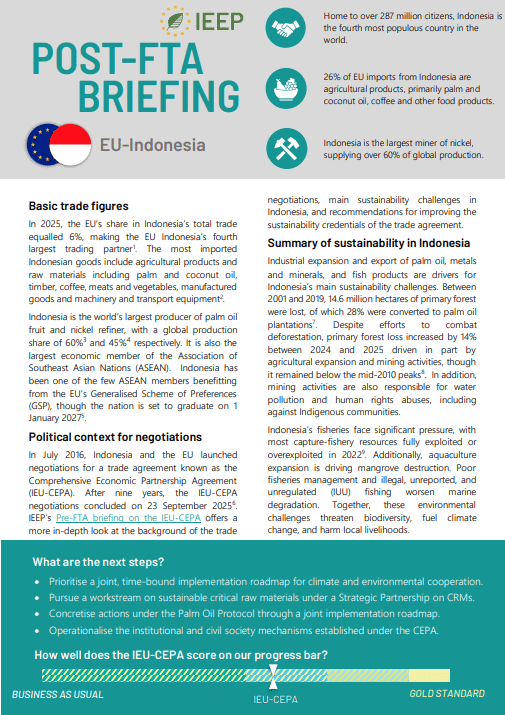
In January 2025, IEEP published a pre-FTA briefing identifying key sustainability challenges that would need to be addressed in the final agreement, particularly commodity-driven deforestation, the environmental impacts of mining and raw-material processing, and pressures on marine resources. With negotiations now concluded, this briefing returns to these issues to assess how sustainability has ultimately been incorporated into the IEU-CEPA.
However, the agreement also illustrates the limits of the EU’s current approach to sustainability in trade policy. Many environmental commitments continue to rely predominantly on cooperation and dialogue, while the scope for temporary remedies in cases of non-compliance remains limited. In resource-intensive sectors, increased trade and investment may also intensify existing environmental pressures unless market access is accompanied by effective implementation of the agreement’s sustainability commitments.
These tensions are particularly visible in raw materials and palm oil. Indonesia’s downstreaming strategy for nickel has generated longstanding trade tensions with the EU but has also raised wider questions about domestic value addition, environmental impacts and the distribution of benefits from the clean-energy transition. The Palm Oil Protocol similarly represents a new attempt to reconcile trade and sustainability interests, but its effectiveness will depend on turning broad commitments on cooperation and capacity building into concrete action, including support for smallholders.
The briefing therefore recommends that the EU and Indonesia:
- Prioritise a joint, time-bound implementation roadmap for climate and environmental cooperation. The roadmap implementation could also inform the Agreement’s review mechanism by providing an assessment of the effectiveness of the TSD provisions, alongside the broader sustainability impacts of the CEPA.
- Pursue a dedicated workstream on sustainable critical raw materials under a Strategic Partnership on CRMs. This should promote the sustainable use of finite raw materials, increased circularity and environmentally sound processing, alongside technology transfer, capacity building and local value addition.
- Concretise actions under the Palm Oil Protocol through a joint implementation roadmap. This should include specific priority actions, time-bound objectives, clearly identified implementation and monitoring bodies, and dedicated financial and technical assistance. Particular attention should be given to ensuring that smallholders are able to benefit from the Protocol.
- Operationalise the institutional and civil society mechanisms established under the CEPA. The Parties should establish the CTSG and its relevant configurations, alongside the DAGs and CSF, to enable effective monitoring of CEPA implementation and impacts and ensure the regular involvement of civil society. Sustainability-related meetings and dialogues should also record agreed actions and systematically follow up on their implementation to strengthen accountability and transparency.
- Translate cooperation on sustainable marine resources and aquaculture into action. The Parties should turn the CEPA’s provisions on monitoring, inspection, technical assistance and capacity building into priority actions addressing marine overexploitation, IUU fishing and sustainable aquaculture, supported by clear objectives and follow-up to ensure measurable improvements in marine resource management.
- Establish a dedicated workstream on CBAM implementation and industrial decarbonisation. In light of growing Indonesian iron and steel exports to the EU, cooperation should support CBAM compliance while promoting longer-term decarbonisation through policy and knowledge exchange, greater circularity and increased use of secondary raw materials.
Ultimately, the sustainability impact of the IEU-CEPA will depend less on the number of environmental commitments contained in its final text than on how effectively they are implemented. As the agreement moves towards ratification and implementation, establishing ambitious and accountable cooperation from the outset will be essential to ensure that deeper EU-Indonesia trade relations support rather than undermine their climate and environmental objectives.