
AUTHORS: Angela Bekkers (WRI), Nora Hiller and Melanie Muro
With three months to go before the EU Deforestation Regulation (EUDR) is enforced, IEEP and World Resources Institute brought together the European Commission and business voices to address the question: are you ready for the EUDR? The answer was a resounding ‘yes’.
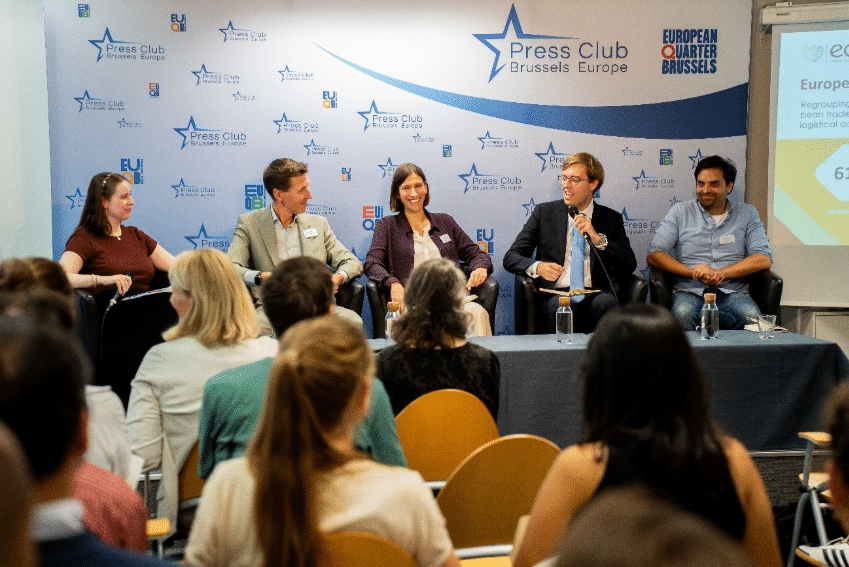
Few EU laws have had as turbulent a path as the 2023 regulation banning deforestation-linked products from entering the European market. A 12-month postponement in 2024, targeted changes and further delay in 2025, a simplification review and a slightly revised product scope this year: the road to application has been long and winding. So when policymakers, experts, business representatives and activists gathered in Brussels just three months before the EUDR enters into application, all attention was on the readiness of the private sector and the practicalities of starting implementation.
Why the regulation matters
Sarah Carter of World Resources Institute (WRI) set the scene with data showing tropical primary forest is still being lost at a rate of 11 football fields every minute. More than 140 countries have committed to halting and reversing deforestation by 2030, yet in 2025 the world was 70% above where it needed to be to for a downward trend. ” We’re running out of time, so the EUDR is a vital tool for getting us anywhere near that 2030 goal”,” she noted. Research found that just six agricultural commodities covered under the EUDR – beef, palm oil, soy, cocoa, coffee and rubber – accounted for 85% of estimated forest loss linked to EU imports.
For IEEP’s Melanie Muro, the link to European food consumption is central. Food was responsible for almost half of the EU’s environmental and climate footprint in 2023, and agricultural expansion is one of the main drivers of forest loss. The EUDR, she argued, is an important piece of legislation to address “our overconsumption”.
The Commission: stability is the message
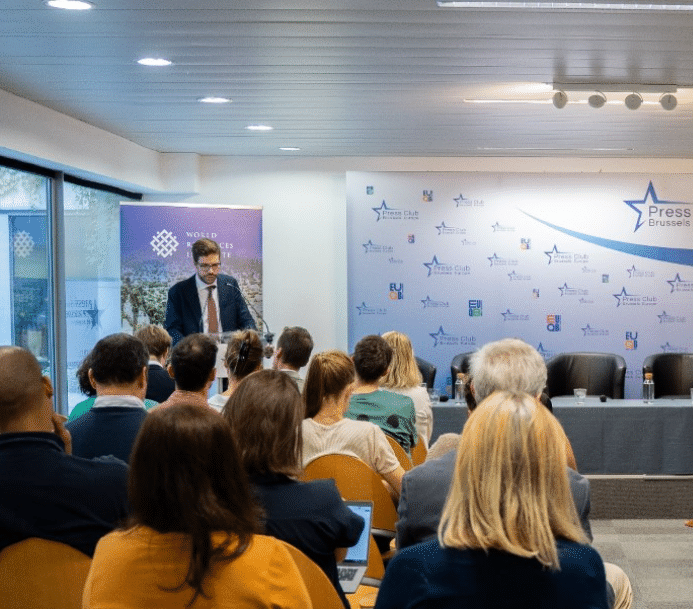
Luis Planas Herrera of the European Commission was clear that the EUDR is already delivering changes on the ground. “We are seeing companies around the world investing in traceability and new digital solutions being developed.” He stressed that the regulation is not only a tool to tackle deforestation, but also provides Europe with more resilience and supply chain transparency. is not only about compliance but about making deforestation-free supply chains the global norm. “Stability is really important because it allows businesses to invest, it allows governments to act, and it allows producers to finalize their preparations.”. The priority now is to keep the momentum, protect the investments made and support Member States and enforcement authorities in ensuring smooth implementation.
Business: “Our systems are ready for implementation. Let’s start and learn”
Perhaps the most notable feature of the event was how far the industry has advanced in preparations for the EUDR despite initial uncertainty, discussed in a panel moderated by IEEP’s Nora Hiller.
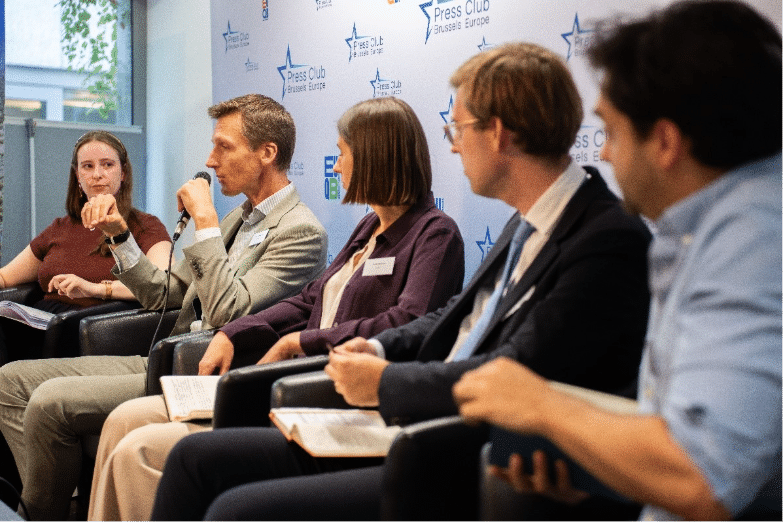
Sarah Rawson from supply chain service provider TRACT, who has worked on the EUDR since 2023, described an evolution in maturity. “Companies have gone from feeling overwhelmed and uncertain, to having greater clarity with processes, tools, and systems with support from associations.” Data that once lived in emails and unstructured files is now flowing through dedicated platforms. As Andrés Ayon from land surveying service provider Meridia put it vividly: companies have gone from “a very messy email with 100 attachments of individual farm plots” to a single solution where a supplier uploads data and everyone in the chain sees the results. Meridia alone has now run almost 10 million unique farm plots through its platform.
Bart Vandewaetere from Nestlé, a company that has supported the regulation from the start and has worked to curb deforestation in its supply chains, noted, “Over the past decade, our voluntary efforts have led to visible changes in our supply chain, but these changes have not been reflected at the landscape level. The supply chain approach is not enough to bring about the changes we want to see, and the greater cooperation being driven by the EUDR is a real game changer.”
Matthijs de Meer from the European Cocoa Association explained how the law has shifted “deforestation-free” from a value-add to a non-negotiable prerequisite. “Deforestation-free was previously a competitive differentiator, but the EUDR has made it an imperative. The power of the regulation is that it puts all companies on a level playing field and it has created a shared interest for everyone to work together.”
Effects beyond the EU
Several speakers pointed to ripple effects far outside the EU. Commodity-producing countries like Ghana and Côte d’Ivoire have significantly strengthened their national traceability systems, with farmers geo-mapped and registered, something Matthijs de Meer called unlikely without the EUDR. A cocoa exporter in Peru reported that buyers in Southeast Asia were already asking for EUDR-compliant cocoa beans, and US coffee buyers are requesting compliant coffee too. Tina Schneider of WRI summed it up: “We’re seeing the changes this policy is having on supply chains that aren’t even touching the EU.”
Some speakers pointed out the value of the data beyond EUDR compliance. As TRACT’s Sarah Rawson put it, traceability and deforestation assessments feed carbon reduction efforts, inform human rights due diligence and unlock insight into farmer productivity. Meridia’s Andrés Ayon said that companies are already looking to see what they can do with the geolocation data they have collected, like calculating the indirect GHG (scope 3) emissions in the value chain.
Nestlé’s Bart Vandewaetere also expects that, over time, more resilient supply chains will mean more stable prices.
What comes next
Speakers realistically expect implementation to be a learning process. Success in year one, according to TRACT, means a culture of openness and continuous improvement, where lessons are shared across the industry. Others hope to see rewards for those who comply, through incentives and premiums, and consistent enforcement across Member States.
The biggest challenge is ensuring smallholders are brought along on this journey. With 130,000 farmers in its cocoa supply chain, virtually all smallholders, Nestlé was emphatic: “A business case based on excluding smallholders will not work in cocoa.” The task ahead is to support them through inclusion rather than exclusion, backed by substantial public and private investment in sustainable agricultural supply chains. The EUDR is one piece, and hopefully the beginning of a much broader transition towards sustainable food systems.
Both IEEP and WRI will keep following implementation closely. The foundations are strong, and the priority now is to make sure they translate into lasting change for the world’s forests.