
The European Climate Foundation (ECF) and the Institute for European Environmental Policy (IEEP) invite you to the launch of the Traded Emissions Tracker — a new tool mapping and presenting the carbon footprint embedded in traded goods, with a dedicated focus on the European Union’s exposure to and influence over embodied emissions across global supply chains.
The Traded Emissions Tracker is now available here.
- Tuesday 8 September 2026
- 15:00 – 18:00 CET
- Residence Palace, Brussels – Room Polak
The event features a fireside chat with
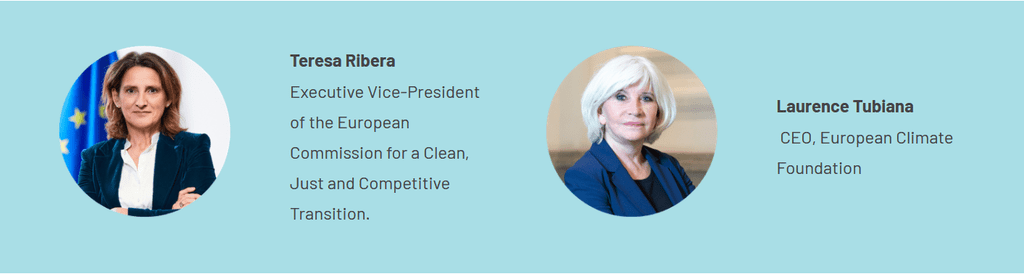
The event brings together policymakers, researchers and civil society to discuss what the data reveals and what it means for EU climate and trade policy. It includes a fireside chat between Laurence Tubiana, CEO, European Climate Foundation and Teresa Ribera, Executive Vice-President of the European Commission for a Clean, Just and Competitive Transition. The conversation will be moderated by Antoine Oger – Executive Director IEEP and will be followed by a panel conversation presenting various views from researchers as well as country and business representatives on the importance of monitoring and regulating imported emissions
WHY EMBODIED EMISSIONS — AND WHY NOW
Today, over 20% of emissions are embodied in international trade. Since 1995, traded emissions have grown faster than global emissions themselves, reflecting the increasing proliferation of global supply chains. As countries take more ambitious measures to reduce their territorial emissions, they also need to wonder about their broader carbon footprint, an issue that sits at the intersection of climate mitigation, industrial decarbonisation and competitiveness.
Addressing imported emissions, whether through regulations, tariffs, or international cooperation, would send a strong message to governments. Countries hoping to attract investment through weaker environmental standards could find their carbon-intensive exports facing barriers in major consumer markets. Conversely, cooperation on ambitious climate standards would become increasingly attractive, and help countries maintain market access while accelerating global decarbonisation. At the level of individual sectors and industries, companies would need to adapt their production methods if they wish to retain access to economies that adopt measures to contain emissions. This would also discourage relocating in so-called “pollution havens”.
Ultimately, imported emissions are where climate policy meets trade policy. Addressing them means recognising that, in a globalised economy, achieving climate neutrality is not only about reducing emissions produced at home, but also about reducing the emissions embedded in what we consume. The topic needs careful unpacking and robust data for objective international discussions. The Traded Emissions Tracker is a contribution in this direction.
PROGRAMME
| 14:30 | Registration & welcome coffee |
| 15:00 | Presentation of the ECF Tracker on Embodied Emissions — European Climate Foundation |
| 15:15 | Fireside chat: Laurence Tubiana (CEO, ECF) & Teresa Ribera (EVP, European Commission), moderated by Antoine Oger |
| 16:00 | Panel discussion, featuring: ・Max van Geuns — Policy Officer, Circular Economy and Climate, Ministry of Infrastructure and Water Management, Netherlands ・Timothy Suljada — Head of Division, Resources, Rights and Development, Stockholm Environment Institute (SEI) ・Leon de Graaf — Managing Partner, Business Advisers on Climate & Competitiveness (BACC); President, Business for CBAM Coalition ・Margherita Bianchi — Head of the Energy, Climate and Resources Programme, Istituto Affari Internazionali (IAI) ・Luc Bas — Director of Belgium’s Climate and Environment Risk Assessment Center (CERAC), Chair of IEEP Strategic Advisory Council |
| 17:15 | Networking cocktail |
| 18:00 | Close |