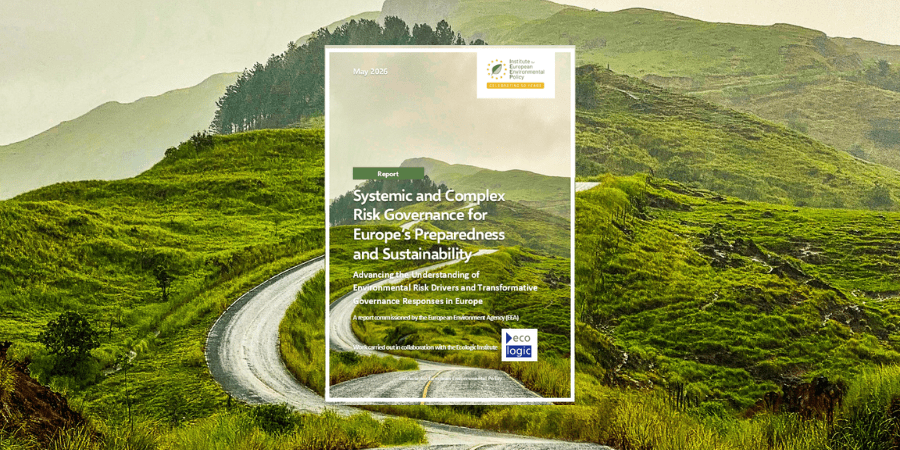
Advancing the understanding of environmental risk drivers and transformative governance responses in Europe
AUTHORS: Louis J. Durrant and Laure-Lou Tremblay (IEEP) and Aaron Best and Ewa Iwaszuk (Ecologic Institute)
The EU faces systemic environmental risks across energy, food, finance and ecosystems. This report shows the need for integrated, anticipatory governance to strengthen resilience, competitiveness and preparedness.
Europe is entering a critical phase in its sustainability and strategic trajectory. Competitiveness, resilience, preparedness, and security have moved to the centre of the European Union’s policy agenda, reflecting a growing recognition that risks can no longer be addressed in isolation. Climate change, biodiversity loss, economic volatility, health risks and social inequalities increasingly interact, reinforcing one another in what is often described as a polycrisis.
In this context, environmental risk can no longer be treated as a sector-specific issue. It unfolds across interconnected systems of energy, food, finance, economy and ecosystems, where risks cascade and compound. These systems do not simply experience risk, they shape how risks emerge, spread and intensify. Understanding these dynamics and how governance mechanisms can transform is essential to delivering the EU’s 2026/2027 policy priorities.
This report examines how environmental risks interact across systems and how transformative governance can respond to growing complexity. It combines structured analysis of environmental risk drivers which are translated into “risk playing cards”, with a qualitative exploration of “risk constellations” across key systems, alongside case studies that operationalise governance-in-complexity principles. Together, these approaches make systemic risk more approachable, discussable and actionable, while retaining its wider systemic context.
A key finding is that systemic environmental risks rarely remain within policy boundaries. They move across systems through shared pathways such as water, land, ecosystems and infrastructure and pollution, generating interdependencies and feedback loops that challenge conventional governance. As a result, the EU’s core policy objectives of competitiveness, resilience and preparedness are increasingly interlinked. Competitiveness depends on system functionality under environmental and geopolitical pressure. Resilience depends on reducing structural vulnerabilities. Preparedness depends on the ability to anticipate and act before risks escalate.
Methodologically, the report shows the value of collaborative and qualitative approaches for working with complexity. Risk driver mapping, risk constellation analysis, and system visualisation provide a structured way to explore interdependencies without reducing them to oversimplified models. These tools support dialogue, shared understanding, and the co-production of policy-relevant insights.
At the same time, the analysis identifies a key constraint: as systems become more interconnected, there is a limit to how much complexity institutions can process. This “complexity ceiling” does not prevent governance, but it reshapes it. It requires deliberate choices and simplifying without distortion, focusing without losing context, and enabling decision-makers to remain oriented within wider system dynamics.
Across the case studies, similar challenges emerge. Uncertainty, timing, tipping points and coordination, alongside the need to act under incomplete knowledge. Effective governance, therefore, depends not only on information and data but also on institutional capacity, shared responsibility and anticipatory action. Building on this, the report operationalises the European Environment Agency’s governance-in-complexity principles as a flexible framework for assessing and improving policy responses. The case studies show that effective governance is forward-looking, cross-sectoral, and context-sensitive, combining anticipation, participation, learning and care in practice.
Taken together, the findings point to a clear shift: Europe’s response to systemic environmental risk must become more integrated, more anticipatory and more transformative. This requires not only better tools for understanding complexity, but also governance arrangements capable of working with interdependence, navigating uncertainty and enabling long-term transitions.
This report was commissioned by the European Environment Agency (EEA)
Report cover photo by Heriberto García on Unsplash