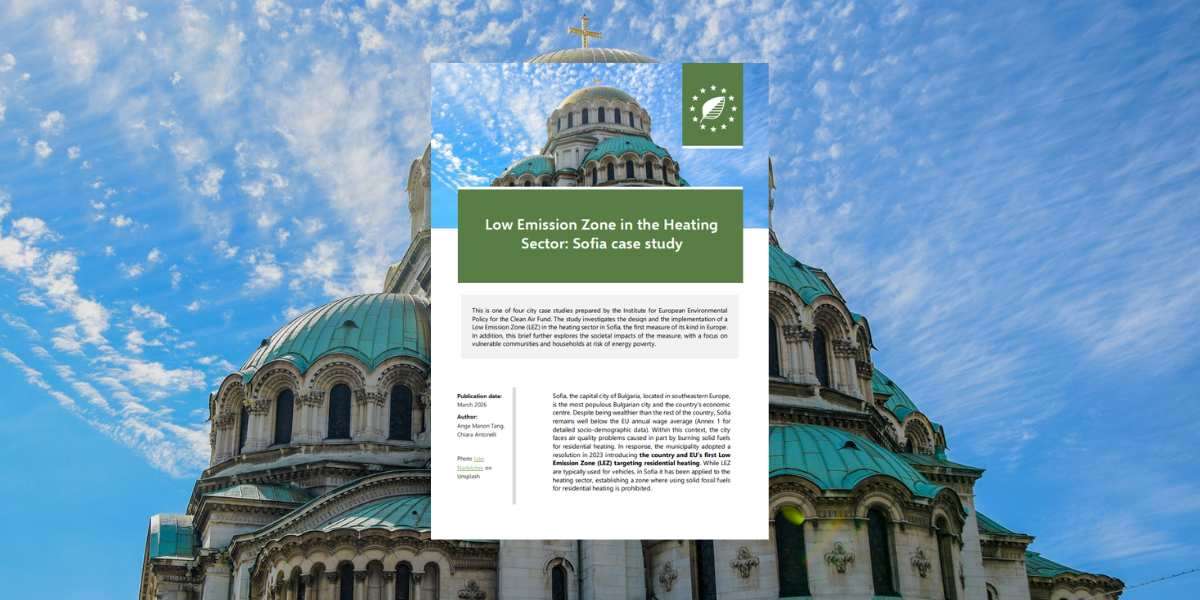
Authors: Ange Manon Tang, Chiara Antonelli
This study investigates the design and the implementation of a Low Emission Zone (LEZ) in the heating sector in Sofia, the first of its kind in Europe. In addition, this brief further enquiries about the societal impacts of the measure, with a focus on vulnerable communities and households at risk of energy poverty.
In Sofia, the capital of Bulgaria, air pollution exceeds both the EU and WHO air quality standards for diverse pollutants, including particulate matter (PM) 2.5. One of the main sources of air pollution is solid fuel appliances. Low-income groups (Roma, elderly, unemployed in suburbs) rely most on these fuels (wood 38%, coal 19%), facing energy poverty, inefficient housing, and pollution hotspots. On top, air pollution costs €2.6 billion per year in health damages and up to 13.4% GDP loss from productivity/absenteeism.
The municipal response has involved the design and implementation of the first Low Emission Zone (LEZ) targeting residential heating in Europe. Since its enforcement in January 2025, the LEZ has been active in nine central districts, with plans to expand to the entire municipality by 2029. This initiative bans the use of solid fossil fuels, such as coal and wood, in areas where gas or district heating is available. Currently, solid fuels supply approximately 32,000 households and contribute to 80% of the exceedances of winter particulate matter (PM) limits, as Sofia’s topography tends to trap pollutants.
The Institute for European Environmental Policy explores the social dimensions of this pioneering case study. The findings focus on the design elements, social acceptability of the measure, stakeholder engagement processes, and concerns regarding energy poverty, especially as they relate to vulnerable groups. Local challenges highlight the need for improved data availability, grid readiness, and robust funding (including from the EU). Several lessons can be drawn from this experience:
- Conduct your research and be transparent. Collect reliable data from different sources to understand the level of air pollution in your city, trying to gather disaggregated data to better assess the impact of air pollution on the population by socio-economic groups and areas.
- Involve all stakeholders from the early stages. Early engagement of the stakeholders will help to better understand the needs of the affected citizens. Minorities and vulnerable communities can play a key role, and yet techniques to adequately target them can be systematically different from standard ones.
- Cultivate proactive and targeted communication. Communication should not focus solely on the ban itself, but rather convey clear, evidence-based messages that resonate with the population, such as the health benefits gained with the measure, comfort financial and non-financial support.
- Adopt a holistic approach. A coherent policy mix works better than isolated measures. When the budget is limited, prioritise what is most important regarding your local context.
- Adopt a “Carrots before sticks” approach. Restrictive measures are more effective and socially acceptable when affordable alternatives are set up in advance to support behavioural change.
Sofia is the first of four case studies prepared as part of a study by the Institute for European Environmental Policy for the Clean Air Fund. The forthcoming studies are Krakow, Madrid and Utrecht.
Download the case study for data, annexes, and interview outputs.
Photo Ivan Nedelchev on Unsplash