AUTHORS: Auriane Flottes de Pouzols, Evelyn Underwood and Alice Albertini
Pollinators like bees, butterflies, moths and other insects rely on healthy, diverse environments to survive. Protected areas, green spaces in cities, and our countryside play a key role by offering safe spaces where these species can feed, nest and reproduce.
The Safeguard project strengthens the knowledge base on pollinator decline across Europe, supporting the EU Pollinators Initiative. Its research and stakeholder engagement contribute to evidence-based actions and policies aimed at protecting and restoring pollinator populations.
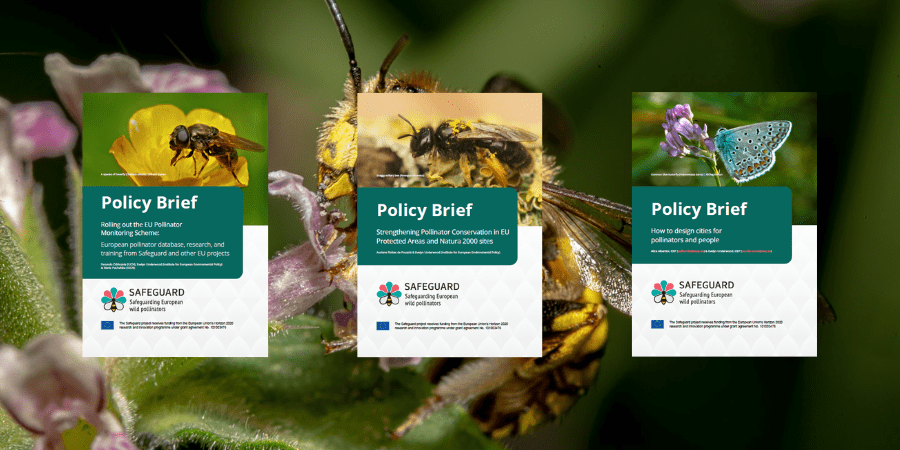
Safeguard is an EU Horizon project that aimed to reverse the loss of wild pollinators across Europe by increasing our understanding of the direct and indirect drivers of pollinator declines, environmental, economic and societal impacts. As part of the project, IEEP has authored and co-authored three policy briefs.
Policy brief 1: Strengthening pollinator conservation in EU protected areas and Natura 2000 sites
‘Strengthening pollinator conservation in EU protected areas and Natura 2000 sites’ shows how to integrate pollinators into Natura 2000 network management and nature restoration planning.
- Simply protecting land is not enough. The quality of habitats matters just as much as their size. Flower-rich areas with a wide variety of plant species are especially valuable, supporting a greater diversity of pollinators. At the same time, features like hedgerows, field margins and well-connected grasslands help pollinators move through the landscape and maintain healthy populations. The research also highlights that managed honeybees can compete with wild pollinators for resources if not carefully managed.
- Pollinators need to be actively considered in how protected areas are managed. A strong policy response means putting pollinators at the heart of Natura 2000 management and nature restoration planning, with targeted measures that protect high-quality habitats and improve connectivity across the wider landscape.
- This practical guidance comes from the PollHab project, which is developing tools to help Member States include typical pollinator species in assessments of Annex I terrestrial habitats for habitat condition reporting under Article 17. By creating criteria for selecting these species, establishing monitoring protocols, and recommending targeted management measures, PollHab ensures that pollinator conservation strengthens Natura 2000 objectives across Europe.
Policy brief 2: How to design cities for pollinators and people
‘How to design cities for pollinators and people’ addresses urban areas, policy- and decision-makers in towns and cities, local-level public authorities, professionals and consulting stakeholders, planners and project developers responsible for the design, implementation and management of green spaces in public areas.
- Commit to becoming a pollinator-friendly city: Cities can embed pollinator objectives across land-use, green infrastructure and climate adaptation policies, integrating pollinator conservation into their urban policies and planning – urban nature plans the EU nature restoration regulation
- One message is very simple – more flowers = more bees and other insects. And more diverse native flowers = more diverse pollinator communities. Use native seed mixtures with a high proportion of perennial and drought-resistant plant species to ensure the long-term establishment of sown areas and prepare for increasingly frequent extreme weather events such as droughts due to climate change.
- Mow urban meadows and lawns less frequently: this is a low-cost simple way to get more flowers and more pollinators- mowing every six to twelve weeks significantly increased pollinator abundance compared to the typical two-week schedule.
Policy brief 3: Rolling out the EU Pollinators Monitoring Scheme
‘Rolling out the EU Pollinators Monitoring Scheme’ shows how Safeguard’s European pollinator database, updated Red Lists, research syntheses, trait and distribution data, and training resources provide the scientific evidence, tools, and capacity needed to implement the EU Pollinator Monitoring Scheme (EU-PoMS) effectively and help achieve the EU’s goal of halting pollinator decline by 2030.
- Implement the EU Pollinator Monitoring Scheme (EU-PoMS) rigorously across member states, using Safeguard’s tools and frameworks.
- Establish and fund a centralised European pollinator database in which member states upload monitoring data to enable real-time data sharing, ensure open access, and avoid fragmentation.
- Establish EU-wide and cross-border coordination to focus on diversity hotspots and threatened species.
- Invest in training national taxonomic experts and building capacity.
- Integrate trait-based and diversity analyses into pollinator monitoring and conservation planning.
Further information: Guidelines for monitoring pollinators in urban habitats
Photo by Akbar Nemati on Unsplash