
This blog was written by Jordan Stock, a master’s student at Stanford University, during her summer placement with IEEP’s Student Programme. It draws on research she conducted during her placement, reflecting her personal interest in regenerative agriculture. The analysis, views and recommendations expressed are her own and do not represent those of IEEP.
If you clicked on this blog post, odds are that you’ve probably heard of the term “regenerative agriculture” before. This is hardly surprising; over the past in the past decade, its use has skyrocketed across policy, farming, and investment circles.
My interest in regenerative agriculture is also personal. I am an American, with family roots in Midwestern farming, and have worked with IEEP’s Nature and Food Systems team. Given my academic background in earth systems and public policy as a student at Stanford University, I was interested in examining how the EU and USA approach the transition toward regenerative agriculture. The goal of this comparison was twofold: first, to analyse differences in public policy approaches to regenerative agriculture; and second, to assess whether these differences have translated into meaningful variation in farmer adoption and private-sector investment (which we define as capital deployed toward regenerative agriculture practices, enterprises, infrastructure, and market mechanisms intended to generate financial returns and/or environmental outcomes).
But, just to make sure we’re all on the same page, regenerative agriculture (or “regen ag” in this blog) refers to the holistic farming approach that focuses on improvements in soil health, carbon capture capabilities, water retention, and biodiversity. At this point, you may be thinking “this is a broad definition,” and you are correct: regenerative agriculture has yet to receive a globally accepted, legal definition. Because of the definition’s broad bandwidth, regenerative agriculture is often either described by practices and principles or by outcomes. On the former, the most common regen ag practices and principles include, but are not limited to integrating livestock, keeping soils covered (and maintaining living roots year-round), maximising crop diversity, minimising soil disturbances, and understanding the context of your farm operation. When regen ag is defined by its outcomes, it typically focuses on soil health, biodiversity, ecosystem services, climate resilience, nutrient cycling, and the long-term viability of farms. Proponents of regen ag, including the American farmer Robert Rodale who coined the term, claim that it differs from other similar approaches (such as organic farming and sustainable agriculture) because it explicitly aims to enhance ecological systems rather than merely sustain existing conditions.
While this idea originated in the 1980s, the concept didn’t really take off until the world faced the soil health consequences of intensive farming. Assessments suggest that conventional farming’s use of heavy machinery, synthetic fertilisers, and pesticides have significantly contributed to the 34% of the planet’s agricultural land being degraded today. To address and counteract this damage, individuals, communities, organisations, and companies have increasingly committed to regenerative agricultural practices, especially over the past decade. In fact, as of 2024, about 24 of the 30 largest food companies in the world used the term in publicly available documents.
From my past two months of research into this topic, it seems to me that in the USA, the discourse around regenerative farming often emphasises the economic benefits of improved soil health for farmers, including productivity, resilience, and profitability, whereas in the EU, there seems to be a greater emphasis on environmental outcomes. I noticed this difference in the language used to frame the motivations behind soil health policies in the discourse in the two regions. However, despite those differences, both American and European policies largely rely on voluntary, opt-in programmes to support farmers in transitioning to regenerative practices (or sustainable practices more broadly). If you’re interested in reading the specific policies, see the US’ Environmental Quality Incentives Program (EQIP) and the EU’s eco-schemes and rural development support for environmental and climate action under the Common Agricultural Policy (CAP).
It is also worth mentioning that USA and EU have somewhat different positions on regenerative agriculture. US agricultural system generally relies more heavily on synthetic fertilisers (per capita) and pesticides than Europe, which can make practices such as no-till farming easier to implement. However, in the EU, the use of synthetics in regenerative agriculture remains highly disputed and has become a major source of concern about potential greenwashing. Notably, the European Alliance for Regenerative Agriculture (EARA), an influential voice on Europe’s regen ag agenda, takes a clear stance against the use of synthetic pesticides. As a result, discussions about what constitutes regenerative agriculture in the EU often focus less on individual practices, such as no-till, and more on whether production systems can reduce or eliminate dependence on synthetic chemical inputs. At the root of this debate, however, is the lack of a clear legal definition of regenerative agriculture.
What also became clear to me were several similarities between the two:
- European and American farmers face similar problems. Operational and social barriers – namely, a lack of technical know-how, uncertainty on how yields (and, thus, profits) will react, and frictions in behaviour changes – impede a smooth and widespread transition to regen ag in both regions. Both groups of farmers also face financial barriers in the form of high upfront capital costs, rigid traditional lending models with long pay-back periods, and temporary yield declines in the early stages of adopting regenerative practices, which all contribute to unsustainable debt burdens that disincentivise farmers from transitioning to regen ag.
- Following the first point, private-sector investment in regenerative agriculture has grown significantly in both the USA and EU in recent years [links 1, 2, 3]. To better understand this trend, I conducted my own analysis using PitchBook, a financial data platform that tracks private-market investment activity. My results can be seen in the two graphs presented at the end of this blog, but it is worth mentioning that PitchBook focuses primarily on institutional investment activity, so it cannot comprehensively capture smaller, non-backed, or hyper-local transactions, which are not uncommon in agricultural business transactions. It also does not capture public funding and subsidies for regenerative agriculture. So, these charts should be viewed as a snapshot of private-sector activity trajectory related to regenerative agriculture, rather than a comprehensive picture of private-sector investment.
- On the subject of private sector investment in regen ag, an increasing amount involves multinational corporations insetting regenerative agriculture practices within their own supply chains to improve supply-chain resilience and meet sustainability commitments. As the measurement and disclosure of greenhouse gas (GHG) emissions has improved, Scope 3 emissions have become an increasingly important focus for corporate climate strategies. International GHG accounting standards distinguish between three scopes: Scope 1 covers a company’s direct emissions, Scope 2 covers indirect emissions from purchased energy, and Scope 3 encompasses other indirect emissions across the company’s upstream and downstream value chain. While companies have historically had greater control over and data for reducing Scope 1 and Scope 2 emissions, Scope 3 emissions are generally more difficult for companies to measure and reduce because they occur across their broader value chains. Furthermore, Scope 3 emissions can constitute a substantial share of total emissions for companies with agricultural supply chain, so, many multinational food corporations seeking to reduce their Scope 3 emissions and to improve the resilience of agricultural supply chains are increasingly turning to regenerative agriculture. A non-exhaustive list of such companies includes Nestlé, General Mills, PepsiCo, and Danone.
While the USA and EU have slightly different approaches to and motivations for moving to regen ag, I believe that the following three policy interventions would help them both catalyse further progress and investment in regenerative agriculture. If you are interested in learning about these policies (and other relevant policy proposals to support a transition to a better agricultural system in the EU), see IEEP’s publications on leveraging private finance for the transition to sustainable agriculture and on the barriers, enablers, and policy opportunities to strengthen the policy framework for ReCAP.
- Address the lack of a clear, legal definition: scholars, policymakers, and practitioners all around the world have called out the absence of a shared definition, as it creates challenges for policy design, measurement, certification, and the comparability of regenerative agriculture initiatives. Various organisations have proposed guiding frameworks; however, there is no consensus on which to use.
- Resolve the lack of standardised methods and metrics for quantifying the environmental benefits of regenerative agriculture creates challenges for both the EU and the U.S. Without these, companies will struggle to demonstrate how they have met their obligations to reduce Scope 3 emissions or satisfied other ESG commitments to shareholders. This difficulty, or inability, to quantify environmental benefits becomes especially problematic when public finance is involved (in the case of blended finance), as public authorities need to demonstrate that funds have meaningfully contributed to achieving policy objectives. So, standardised MRV (Monitoring, Reporting, and Verification) methods and KPIs (Key Performance Indicators) would improve transparency, comparability, and accountability.
- Expand use of blended finance and risk-sharing mechanisms that combine public funding and private investment to help reduce the upfront financial burden and transition risks faced by farmers. Experts and policy specialists around the world have identified blended finance and risk-sharing mechanisms as crucial tools in overcoming the high upfront costs of adopting regen ag practices and equipment, improving farmers’ access to capital, and attracting private investment while leveraging public funding [links 1, 2, 3]. Crucially, these mechanisms should use public funding to provide concessional finance and absorb some of the transition risk, while mobilising private capital to finance the remainder, given the limited capacity of public budgets to fund the full regenerative agriculture transition.
Trends in private-sector investment activity related to regenerative agriculture in Europe, 2006-2025 (deal count and median deal size) (Source: PitchBook)
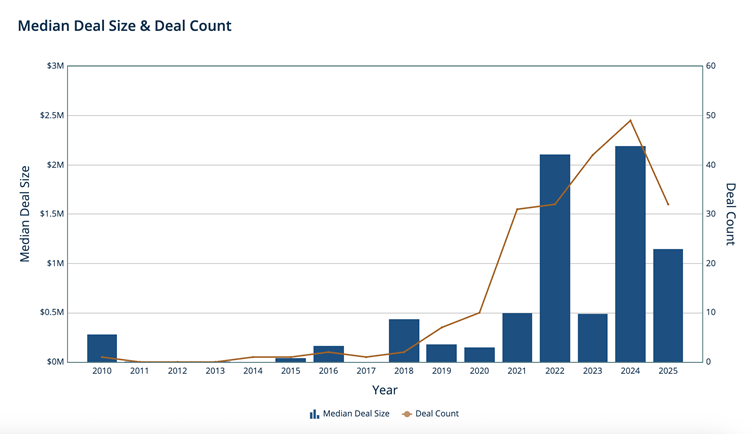
As shown above, private-sector activity in Europe’s regenerative agriculture sector has increased substantially over the past decade. The spike in deal activity in 2024 is particularly notable and may have been driven in part by the European Parliament enacting the Corporate Sustainability Reporting Directive (CSRD), under which companies in the first reporting wave were required to apply the new sustainability reporting rules for the 2024 financial year.
Trends in private-sector investment activity related to regenerative agriculture in the United States, 2006-2025 (deal count and median deal size) (Source: PitchBook)
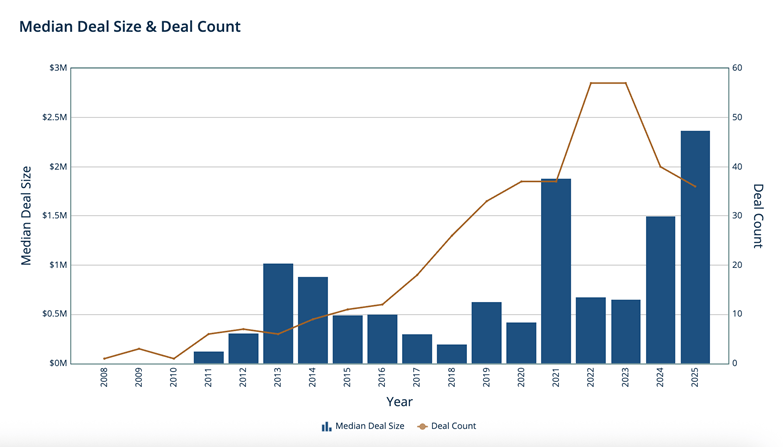
The decrease in deal count from 2023 to 2025 may reflect a shift in the U.S. policy environment following the transition from the Biden to the Trump administration. The Biden administration (January 2021– January 2025) established a favourable policy environment for climate and environmental sectors, including through major legislation such as the Inflation Reduction Act (IRA), which was passed in August 2022. However, once Trump returned to political office, his administration rolled back various environmental programs and policies, which could have contributed to the lower deal count in private-sector environmental investment activity from 2024 on.
Methodology of PitchBook chart creation:
- Searched “regenerative agriculture” in the search bar. It is considered an “analysts content,” labelled as an “emerging space” within “Materials and Resources.” As of my work in mid-August, the quick statistics associated with regenerative agriculture are $3.80 billion invested, 717 companies, 1000 deals, and 950 investors (all of these values are global and cumulative).
- Scroll to “Deals over Time” on the initial regenerative agriculture page and click on “View all deals.” I am choosing to keep all types of deals selected because I want to capture the full range of private-market activity associated with regen ag, rather than limiting the analysis to a single type of transaction.
- On the bar above the chart, hover over “Chart” options and select “Deals.”
- On chart settings, change the time period to 20 years and keep deal count selected as a line graph and “median deal size” for bar graph type. To not include 2026 (since the year is still ongoing and including partial-year data could artificially depress the apparent level of activity), click on “Modify criteria” and write 31 December 2025 as the end date under “Deal date.” Keep the start date empty.
- Also in the “Modify criteria” drop-down, select only Europe, keeping all European regions selected, and then click “search” to get the first chart below. Repeat this process but change the selection to only include the U.S. for the second chart. As a validation check, you should get 71 results when selecting the criteria to create the Europe chart and 112 for the USA.
Photo by Markus Winkler and Ann (blog cover) on Unsplash