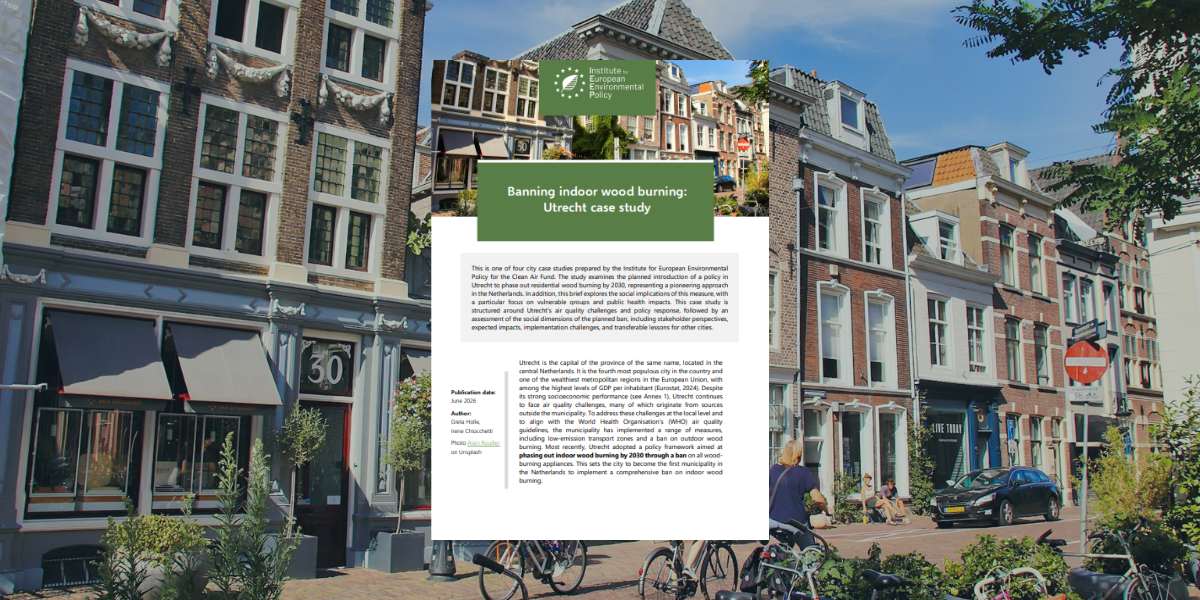
AUTHORS: Greta Holle and Irene Chiocchetti
This brief explores the planned introduction of a policy in Utrecht to phase out residential wood burning by 2030, representing a pioneering approach in the Netherlands. It also focuses on its social impacts, with particular attention on vulnerable groups and public health impacts. The latter has been a key driver for the municipality’s increased action on air quality.
While there is already a ban on burning wood externally, the city of Utrecht has taken further steps to comply with the WHO guidelines. The policy is not expected to have major impacts on citizens, as wood burning is typically associated with recreational activities, most often higher-income homeowners. In addition, the relatively few cases where wood-burning stoves are used as the primary heating source, the municipality plans to introduce exemptions, following a careful assessment of impacts on vulnerable households who cannot afford alternative heating options. Moreover, a subsidy scheme for device replacement was available from 2021 to 2025.
Utrecht provides an interesting case in particular, due to its long-term planning ahead of the ban coming into force. Since 2021, the municipality has conducted extensive communication campaigns, such as via online questionnaires and street interviews, to ensure that all citizens, including hard-to-reach groups, are aware of the upcoming policy and its implications.
At present, the measure has received mixed reactions from the public. On the one hand, supporters recognise the significant benefits for air quality, public health and general wellbeing, while opposers see the ban as a restriction on personal freedom and lifestyle. Although the municipality is overall satisfied with the reception, it will be crucial in the coming years to continue information campaigns and further build public acceptance of the policy.
IEEP’s initial transferrable lessons, particularly regarding the pre-implementation stage, can be summarised as follows:
- Including public engagement early and gradual implementation improves public acceptance and allows municipalities to identify potential social impacts before introducing more restrictive measures.
- Addressing social concerns through targeted exemptions and support measures, even when affecting a relatively small number of vulnerable groups.
- Emphasising the positive impacts, especially the public health benefits, of air quality policies, while highlighting the multiple co-benefits of a healthy environment and the overall community well-being.
This work has been produced with financial support from the Clean Air Fund.
Photo by Alain ROUILLER