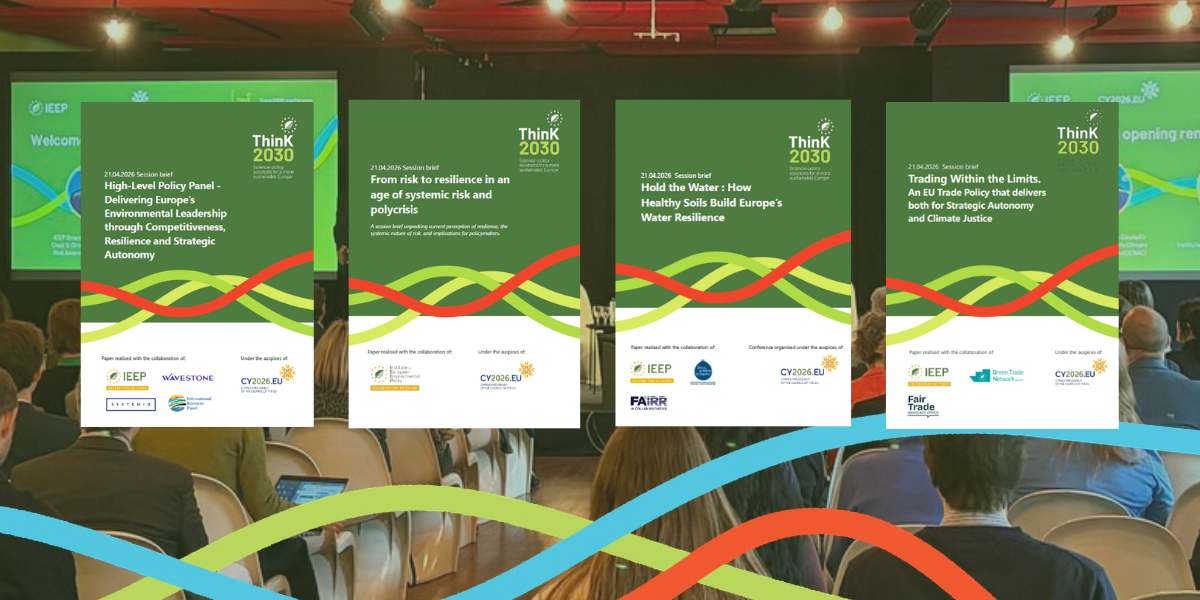
Europe has entered a new era in which climate change, resource scarcity, geopolitical instability, economic competitiveness and social resilience can no longer be treated as separate policy challenges. The Think2030 Conference Cyprus – IEEP 50th Anniversary, held on 21 April 2026, brought together European policymakers, business leaders, researchers and civil society representatives to examine how Europe can deliver on its environmental ambitions while strengthening competitiveness, resilience and strategic autonomy in an increasingly volatile world.
A central message emerging from the conference was that sustainability is no longer a standalone environmental agenda: it has become a core economic, industrial and security imperative. The discussions highlighted that Europe’s future prosperity will depend not on lowering environmental ambition, but on its ability to implement existing commitments, accelerate innovation, reduce strategic dependencies, and strengthen resilience to climate and geopolitical shocks. Translate long-term goals into concrete action across sectors and value chains will be a key element in the next decade.
This series of policy briefs captures the key insights and recommendations from the four conference sessions. The briefs explore how Europe can:
Together, they offer a forward-looking agenda for building a more resilient, competitive and sustainable Europe.
As Europe moves from setting ambitions to delivering results, these briefs underline a common conclusion: environmental sustainability, economic resilience and strategic autonomy are mutually reinforcing objectives. The challenge ahead is not defining the direction of travel, but building the governance, investment frameworks and implementation capacity needed to deliver transformation at the speed and scale required.
The Think2030 events are organised by IEEP in collaboration with its partners and under the auspices of the country holding the Presidency of the Council.