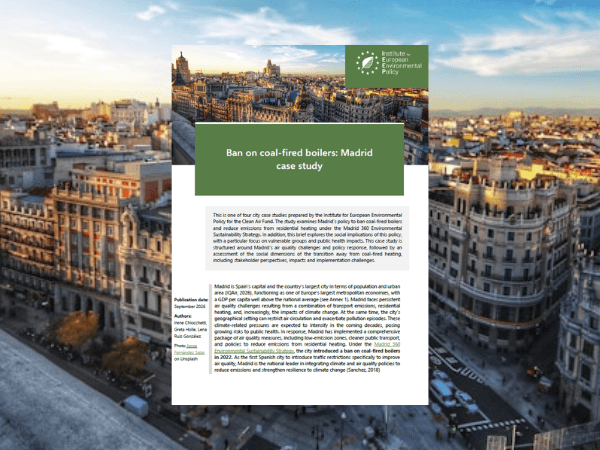
AUTHORS: Irene Chiocchetti, Greta Holle, Lena Ruiz González
This case study examines the introduction and entry into force of Madrid’s ban on coal-fired boilers, effective from 2022. As part of the Madrid 360 Environmental Sustainability Strategy, the measure aims to reduce emissions from residential heating across the city.
The case of Madrid is particularly interesting as an illustration of how a policy framework can address air quality and climate challenges in the context of a densely populated European capital, facing increasing pressure from climate change-related phenomena.
In response to persistent air quality issues driven by high emission levels from transport, residential heating, and climate change, the municipality introduced the Air Quality and Climate Change Ordinance (OCAS) in 2021. The ordinance, alongside other emission reduction measures, established a ban on coal-fired boilers starting from 1 January 2022. At the time of announcement, the ban applied to approximately 200 remaining coal boilers in the city. Additionally, to support the renovation of affected installations, the City Council launched the Cambia 360 grant programme, a subsidy scheme covering up to 60% of each renovation’s investment costs.
The OCAS policy package incorporated a participatory design process, including public consultations with citizens and local organisations and information sessions for affected residents, while contact with these residents was maintained throughout and after the implementation phase. In terms of public acceptance, the limited scope of the ban resulted in minimal resistance, which originated primarily from affected residents and subsided once renovations were completed. However, some environmental and social justice organisations raised concerns regarding vulnerable groups, noting that some directly affected residents had retained their outdated systems precisely because they could not afford prior renovations.
IEEP identifies the following transferable lessons from this case:
- Treating air pollution and emission reduction as two sides of the same coin, addressing them under a common framework allows for more effective and far-reaching outcomes.
- Maintaining close contact with citizens before, throughout and after implementation, facilitating a participatory design approach while enabling continuous monitoring and the integration of feedback to enhance effectiveness.
- Ensuring gradual and flexible implementation, as focusing on incentives and support schemes rather than rigid penalties for non-compliance proved more efficient.
- Sustain momentum on clean heating. Given that measures such as this ban affect only a small number of installations, it is essential to continue with ambitious initiatives to create coherence and achieve more impactful results.
To find out more about IEEP’s work on clean air policy and scalable solutions and best practices to improve air quality and decarbonisation in Europe, register for our event on 20 October, “Beyond the smoke: Building support for clean heating measures in Europe“.
Briefing cover photo by Jorge Fernández Salas on Unsplash